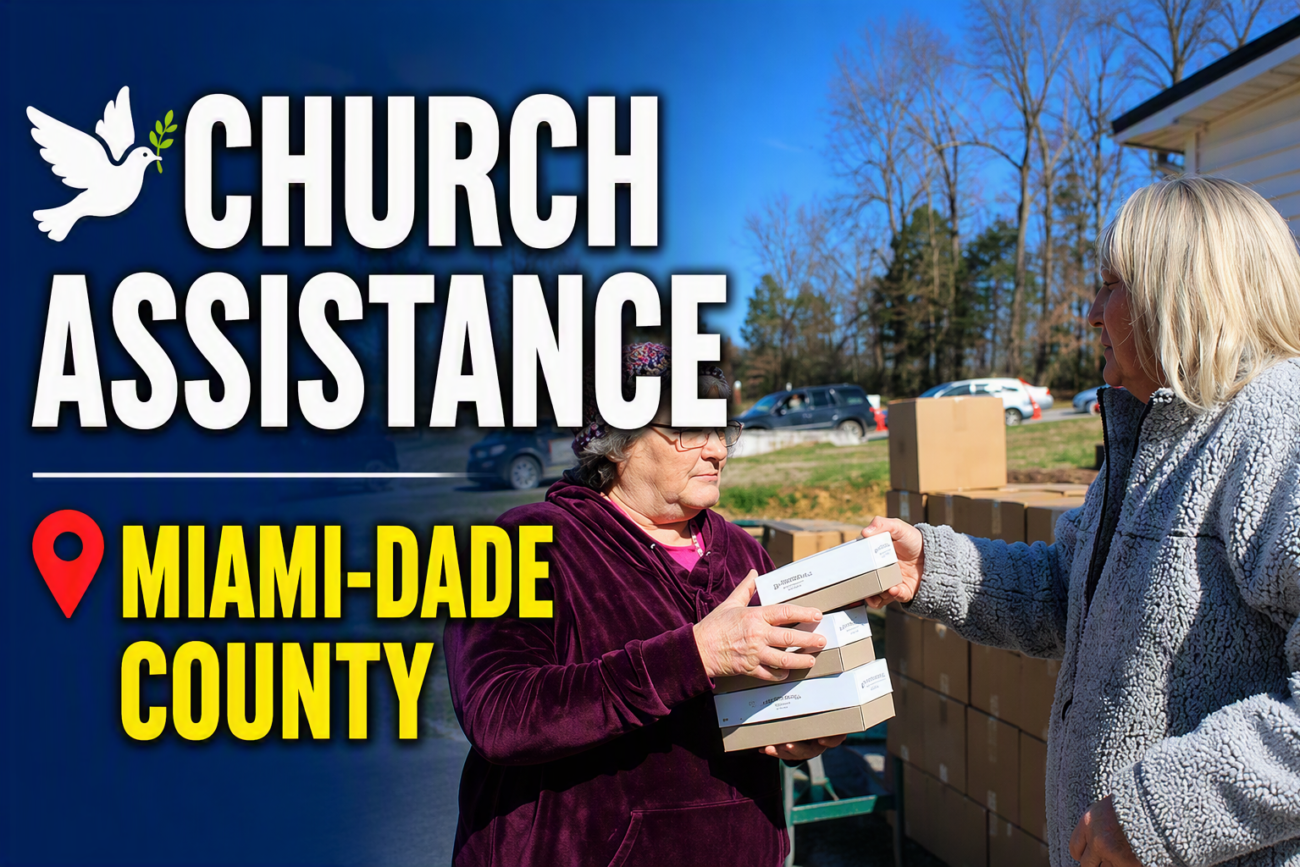
If you are facing an emergency in Miami-Dade County, various religious organizations and church networks offer essential assistance with rent, utility bills (such as FPL), emergency housing, and food. Most of these programs serve all residents in need, regardless of religious affiliation.
Since funds are often limited and allocated on a first-come, first-served basis, it is highly recommended to call early and have proof of financial hardship (such as an eviction notice or an overdue electricity bill) on hand.
Catholic Charities of the Archdiocese of Miami
Catholic Charities of the Archdiocese of Miami manages a comprehensive network of social service programs across Miami-Dade, Broward, and Monroe counties. These programs are designed to stabilize families facing financial crises, support vulnerable seniors, and provide specialized care for youth and immigrant populations.
Each assistance program has its own eligibility criteria, and core emergency services operate strictly by appointment.
Emergency Financial Assistance and Housing Stability
The Homeless Prevention and Rapid Re-Housing Program serves as the primary financial assistance mechanism for residents facing imminent eviction or utility disconnection.
Rent and Mortgage Assistance: Direct financial aid paid to landlords or lenders to halt active eviction or foreclosure proceedings.
Utility Assistance: Emergency financial aid for overdue electricity (FPL) or water bills to prevent service disconnection.
Vouchers for Essential Items: Distribution of emergency vouchers for food and diapers to low-income families.
Housing Facilities: Management of various permanent and temporary housing centers offering short- and long-term accommodation for the homeless.
How to access: Miami-Dade residents can contact the Emergency Services Hub by calling 305-573-3333 or emailing newlife@ccadm.org. The office is located at 3620 NW 1st Ave, Miami, FL 33127; however, walk-ins are not accepted.
Independent living support for seniors
Catholic Charities manages local support systems designed to help seniors safely maintain their independence in their own homes.
Community meals at senior centers: Management of various community dining sites serving hot meals, such as those at the Malcolm Ross Senior Center and St. Monica Gardens. These centers offer hot, nutritious daily lunches, organized social activities, and local wellness checks.
Meals on Wheels: Delivers nutritious meals—either fresh or flash-frozen—directly to homebound seniors who are unable to cook or travel on their own.
Case management for seniors: Assigns specialized social workers to assess seniors’ needs, coordinate medical appointments, and facilitate access to legal or financial assistance.
Immigration Services & Refugee Resettlement
Through Catholic Legal Services (CLS), the Archdiocese offers extensive legal and transitional assistance networks specifically aimed at immigrant populations in South Florida.
Legal representation: Low-cost or pro bono (free) immigration law consultations, assistance with completing complex government forms, and direct court representation for refugees and asylum seekers.
Unaccompanied minors program: Offers specialized housing, medical screenings, trauma-informed mental health counseling, and education for undocumented youth while family reunification is being arranged.
Resettlement assistance: Processing of work permits, job placement services, and basic orientation for newly arrived migrants integrating into the U.S. labor market.
Child development and family behavioral health
Early childhood education (Head Start): Offers comprehensive child development programs, preschool readiness curricula, and medical and nutritional assessments for children from low-income families.
Behavioral health counseling: Clinical counseling programs designed to equip low-income families, couples, and youth with strategies to cope with systemic stressors, trauma, and family crises.
St. Luke Center: A division dedicated to substance and alcohol abuse treatment, offering specialized recovery programs in both residential and outpatient settings.
Society of St. Vincent de Paul (South Florida Council)
The Society of St. Vincent de Paul (South Florida Regional Council) is a volunteer-led Catholic lay organization that provides direct, personalized assistance—covering both basic needs and emergency financial aid—to low-income families.
Unlike centralized government agencies, St. Vincent de Paul operates through parish-level volunteer groups known as “Conferences.” In South Florida, more than 1,200 volunteers (known as Vincentians) manage nearly 70 local parish conferences spanning Miami-Dade and Broward counties.
Core Assistance Programs
Since funds are generated locally through parish collections and charity shop proceeds, services focus primarily on immediate crisis resolution:
Emergency housing assistance: Direct, one-time financial aid to pay overdue rent or mortgage payments. Payments are issued directly to the landlord or lender to prevent pending eviction or foreclosure.
Utility bill assistance: Short-term financial aid to cover overdue electricity (FPL) or water bills. Volunteers help arrange partial payments to prevent service disconnection.
Food and nutritional support: Parish conferences maintain local food pantries, coordinate emergency food baskets, and provide grocery vouchers directly to families facing immediate food insecurity.
“Home Visit” program: Rather than operating solely from an office, Vincentian volunteers traditionally conduct in-person home visits. This allows them to meet families personally, assess the household’s full range of needs, and determine the best combination of emotional, financial, and logistical support.
Burial assistance for the indigent: A specialized regional service providing a dignified burial or funeral arrangements for families unable to afford basic funeral costs.
Resource referral and guidance: Advice on household budgeting and job training resources, as well as immediate referrals to county-supported programs if the household’s financial crisis requires long-term follow-up.
How the application process works
Making the call: To request assistance or find out which local parish jurisdiction you fall under, you must call the regional intake hotline at 954-395-6817.
Leaving detailed information: Since intake lines receive a high volume of calls, you must leave a clear voicemail stating your full name, accurate phone number, city, zip code, and the type of assistance requested (e.g., rent or utility bill).
Parish Assignment: The central council matches the zip code with the nearest active parish conference (based on local parish zones listed in the South Florida St. Vincent de Paul directory).
Volunteer Call-Back: A volunteer from that specific neighborhood parish will return the call to conduct a preliminary telephone assessment and schedule a formal intake appointment or a home visit.
The Salvation Army – Miami Area Command
The Salvation Army – Miami Area Command: Operates as the administrative and social services hub for all Salvation Army programs in Miami-Dade County. From its main facility in Allapattah, the Command manages emergency shelters, financial crisis grants, addiction rehabilitation networks, and local food banks.
All assistance services are faith-based and offered to the public without discrimination.
Key Assistance Programs
Emergency Shelter (Center of Hope): Located at the Allapattah complex, the Center of Hope shelter is a 258-bed emergency housing facility. It features shared units designated for single men, single women, families with minor children, military veterans, and individuals living with HIV/AIDS. A stay includes access to medical consultations, on-site computer labs, and bi-weekly personalized case management sessions aimed at rapid rehousing.
Utility, Rent, and Mortgage Assistance: Provides direct financial aid to low-income households experiencing a sudden drop in income. Staff work directly with providers to make partial payments toward past-due rent, mortgage balances, and FPL electricity bills, helping families remain in their homes and avoid homelessness.
Food Security Infrastructure: Distributes over 500 bags of food weekly—containing both non-perishable and fresh items—sourced through partners such as Farm Share and Feeding South Florida.
Adult Rehabilitation Center (ARC): Located near Midtown, the Miami Adult Rehabilitation Center offers a free, comprehensive, long-term residential program for individuals struggling with substance abuse and alcohol dependency. The program includes emotional therapy, spiritual counseling, and vocational rehabilitation components.
Pathway of Hope: A specialized programmatic initiative focused on breaking cycles of intergenerational poverty. Participating families receive dedicated, long-term follow-up to systematically overcome underlying barriers, such as the need for job training, chronic food insecurity, and a lack of adequate transportation.
Service Locations and Direct Contact Directory
Rather than visiting without an appointment, applicants should coordinate with the specific local command or neighborhood community center (known as a “Corps”) nearest to their zip code:
| Location / Branch | Primary Focus / Services | Direct Contact & Address |
|---|---|---|
| Miami Area Command & Center of Hope | Administrative Hub, Housing Intake, Emergency Shelter, and Financial Support | 305-456-5850 / Alternate: 305-637-6700 1907 NW 38th Street, Miami, FL 33142 |
| Miami Citadel Corps | Little Havana Neighborhood Food Pantry & Community Youth Programs | 305-545-9164 911 W Flagler Street, Miami, FL 33130 |
| Miami Sunset Corps | South Miami-Dade Area Community Grocery Assistance & Fellowship | 305-270-9373 8445 SW 72nd Street, Miami, FL 33143 |
| Miami North Corps | Little Haiti & North Miami Grocery Bag Distributions | 305-757-1509 2147 NW 38th Street, Miami, FL 33142 |
| Adult Rehabilitation Center | Long-Term Inpatient Drug & Alcohol Recovery | 305-573-4200 2236 NW Miami Court, Miami, FL 33127 |
How to Seek Financial and Shelter Help
- For inquiries regarding shelter beds: Most shelter admissions are managed through the Miami-Dade County Homeless Trust referral system. However, the Center of Hope allocates a limited number of emergency beds daily under an “Open Door” policy; these are available to individuals who arrive in person or complete a preliminary telephone assessment. Call the facility’s main line early in the morning to check bed availability.
- For rental or utility assistance: Contact the Area Command social services office. To access financial aid, you must demonstrate a current crisis situation and provide a copy of your lease agreement, official identification, and verifiable proof of a sudden loss of income.
Church World Service (CWS) – South Florida
Church World Service (CWS) – South Florida operates as a leading faith-based cooperative ministry dedicated to welcoming, integrating, and assisting refugees, immigrants, asylum seekers, and survivors of human trafficking.
Unlike general parish-based charities that focus strictly on local emergency aid (based on zip codes), CWS operates through state and federal partnership agreements to manage a comprehensive infrastructure for resettlement, low-cost legal assistance, and job readiness networks across South Florida.
Key Integration and Assistance Programs
Matching Grant Program: An intensive, highly structured pathway designed to help eligible newcomers—including refugees, asylees, Cuban or Haitian entrants, and Special Immigrant Visa (SIV) holders—achieve full financial self-sufficiency within 120 to 180 days of arrival.
Financial support: Provides direct economic assistance for essential household expenses, housing or rent subsidies, and transportation costs.
Professional services: Offers direct guidance on job searching, interview preparation, childcare resource coordination, and permanent job placement.
Enrollment rule: Generally, eligible individuals must enroll within 31 days of obtaining their qualifying immigration status.
Low-cost and pro bono legal services: CWS legal professionals and paralegals help clients navigate the complex U.S. immigration system. They assist with the preparation and filing of petitions, applications for adjustment of status, and work authorization forms, as well as with court representation.
While they charge nominal fees to some clients, services are entirely free for eligible individuals admitted from Cuba or Haiti, as well as for asylees and refugees, through the Florida State Refugee and Entrant Services Program.
U.S. Reception and Placement Program: Working closely with the U.S. Department of State, CWS leads the core reception framework for newly arrived international refugees. This includes meeting families at the airport, managing their initial furnished apartments, and providing emergency food, clothing, and basic cultural orientation.
Specialized Refugee Case Management: Offers case monitoring and coordination for specific displaced populations, including dedicated workflows such as the Case Management Program for Ukrainians.
Post-Arrival Emergency Housing Fund: A specialized safety-net fund offering temporary financial assistance to newly resettled individuals facing unforeseen, short-term crises that put their housing or utilities at risk.
Local Church Ministries and Additional Food Banks
When major funding networks have limited resources, these local church ministries offer targeted assistance:
King Jesus Ministry (Ministerio Internacional El Rey Jesús): Based in Miami, they manage an extensive community resource network offering food assistance, local family support, and direct guidance on accessing community resources. Learn more by consulting the King Jesus Community Resource Guide.
Curley’s House Ministries: A high-impact ministry founded by local Christians that provides free food, bulk groceries, and clothing to families in Liberty City, Brownsville, Allapattah, and Little Haiti.
Camillus House and Miami Rescue Mission: Faith-based ministries serving as major hubs in Miami for emergency shelter, daily hot meals, clothing, and transitional housing programs.
Essential Support Options
Since church funding can vary from month to month, always supplement your search with these county-backed programs:
Miami-Dade Community Action Agency (CAHSD): This county department administers the Low-Income Home Energy Assistance Program (LIHEAP) and can provide significant aid for electricity bills and emergency rent payments. Call 786-469-4600 or visit one of the Miami-Dade Community Resource Centers (such as the Naranja or Perrine centers).
Florida 211 Helpline: Dialing 2-1-1 from your phone connects you with an operator who can check a local database of smaller neighborhood churches that have active grants to assist with utility and rent expenses.
