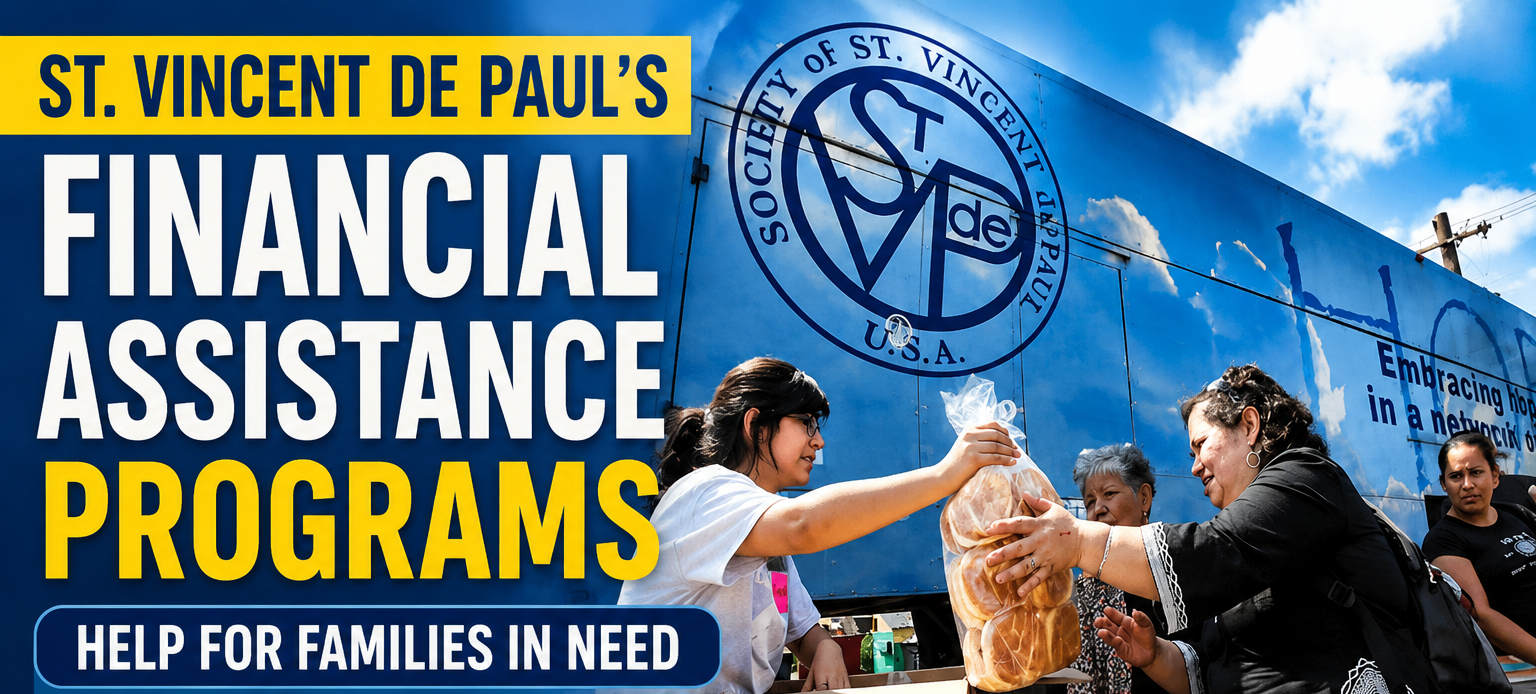
The Society of St. Vincent de Paul is a global Catholic lay organization founded in Paris in 1833 by Blessed Frédéric Ozanam. The organization provides emergency financial assistance to help individuals and families avoid eviction, utility shut-offs, and hunger. Because it operates through a decentralized network of local parish groups—known as “Conferences”—all aid is strictly local in nature and depends on the availability of funds within a specific zip code.
The Society of St. Vincent de Paul assists people experiencing temporary financial crises. Volunteers work directly with individuals and families to understand their situations and provide practical support whenever possible. They also provide direct emergency financial assistance to those facing short-term financial hardship, focusing primarily on preventing homelessness and meeting basic needs. Rather than handing cash to individuals, the Society makes payments directly to landlords, utility companies, or service providers.
Types of St. Vincent de Paul’s Financial Assistance Available and how to get them
Housing and rent assistance programs
The Society of St. Vincent de Paul (SVdP) in the U.S. operates an extensive network of housing and rental assistance programs nationwide. Guided by the national directives of its Housing Task Force, local chapters (known as “Conferences”) mobilize tens of millions of dollars annually to prevent evictions, secure permanent housing, and support individuals experiencing homelessness.
Eviction prevention and direct rental assistance: SVdP’s most widely accessible housing program is its local emergency eviction prevention initiative. SVdP helps families catch up on overdue rent when unexpected medical expenses, job loss, or household emergencies put their housing at risk. Many local chapters collaborate with eviction courts to provide financial intervention after a tenant receives a formal eviction or “notice to vacate” letter. Payments are made via check directly to the landlord or property management company, never to the client.
These programs rely entirely on local funding and SVdP’s foundational model of home visits. Volunteers visit the home to assess the financial situation and verify documentation before approving assistance.
Rapid Rehousing programs: For individuals and families currently experiencing homelessness, some large-scale regional SVdP councils manage structured rapid rehousing initiatives. While standard emergency rental programs rarely cover initial move-in costs, rapid rehousing caseworkers are authorized to pay security deposits and the first month’s rent. Tenants receive comprehensive, personalized support from housing specialists to achieve financial stability and avoid future housing crises. Regional affiliates such as St. Vincent de Paul CARES specialize heavily in this model.
Permanent supportive housing and transitional housing: In many large metropolitan areas, the SVdP acts as a property manager, owning or operating housing complexes for low-income individuals and transitional shelter systems. Many SVdP chapters collaborate directly with the federal government to administer the HUD-VASH voucher program, connecting homeless veterans with permanent housing and free support services. From cold-weather shelters to day centers offering showers, meals, and social work services, the SVdP provides the initial safety net needed to begin the search for permanent housing.
Note: You can only receive grantfrom the specific parish chapter that covers your exact zip code or neighborhood. Most local SVdP rental programs are designed strictly as one-time emergency measures. Many chapters enforce strict rules preventing the same household from receiving rental assistance more than once every few years.
Utility bills assistance
The Society of St. Vincent de Paul (SVdP) in the U.S. offers local assistance with utility bill payments to prevent households from losing electricity, gas, heating fuel, water, or sewer services. Through its local parish-based groups (known as “Conferences”), SVdP assists individuals who have received imminent disconnection notices or whose services have already been shut off.
Because SVdP operates via a decentralized network, specific assistance programs depend largely on local parish fundraising and regional partnerships with utility companies:
Direct intervention regarding disconnections: SVdP specializes in emergency crisis management. If you present a formal service disconnection notice, the local conference may issue a voucher or a check made payable directly to the utility provider to postpone or cancel the disconnection.
Joint contributions and co-payments: If your bill exceeds the amount a single SVdP conference can cover (e.g., $800), volunteers often pledge a specific sum (e.g., $300) and coordinate with other charitable organizations—such as the Salvation Army—or state agencies to secure the remaining balance.
Utility program administration: In several major metropolitan areas, regional SVdP councils directly administer fuel funds financed by utility companies themselves or state emergency grants from LIHEAP (Low Income Home Energy Assistance Program), acting on behalf of the government or private energy companies.
Bulk fuel and firewood delivery: For low-income rural households relying on oil, propane, or firewood for winter heating, some conferences organize and pay for the physical delivery of fuel to ensure the safety and well-being of families.
Please note that SVdP never distributes cash or checks directly to individuals. All approved financial assistance is issued via a voucher or check payable exclusively to the utility company (e.g., Duke Energy, PG&E, National Grid); to access these funds, participation in an SVdP home visit is required. Two “Vincentian” volunteers will schedule an appointment to meet with you at your home. They will review your utility bills, analyze your household budget, and work with you to find a sustainable, long-term solution.
Documents to keep while appying
When SVdP volunteers review your case, you should have the following documents ready to verify your situation:
Complete, unpaid utility bill: Must show the utility account number, the name of the account holder (matching the ID of an adult resident), and the service address.
Official disconnection notice: If requesting emergency funds, you must present the physical service termination or past-due payment notice indicating the scheduled date for service suspension.
Proof of income: Pay stubs from the previous month, unemployment benefit statements, or government benefit letters (SSI, SSDI, TANF, SNAP) for all adults in the household to confirm genuine financial hardship.
Food boxes and free grocery vouchers
The Society of St. Vincent de Paul (SVdP) USA operates one of the largest food assistance networks in the country. Because access to food is considered an immediate, basic human need, SVdP food programs often have a faster intake process than their financial assistance programs for rent or utilities.
SVdP food boxes and home deliveries: For individuals with limited mobility, seniors, or families without reliable transportation, SVdP uses its unique neighborhood network to bring food directly to your door. Unlike traditional food banks that require waiting in line, local SVdP volunteers (known as “Vincentians”) prepare boxes containing non-perishable items, fresh produce, and dairy products, and deliver them directly to your home. Food boxes are generally prepared based on family size. They often include staples such as rice, pasta, canned proteins, cereal, and peanut butter, as well as seasonal items.
Free grocery vouchers: When local chapters do not have a physical food bank, or if a family has specific dietary, medical, or child-related needs, SVdP issues grocery vouchers. These vouchers function like gift cards but are subject to strict guidelines. They may only be used to purchase food, infant formula, and basic hygiene products. Purchasing alcohol, tobacco, or lottery tickets is strictly prohibited, as are transactions to obtain cash. Vouchers are also issued allowing families to visit local SVdP thrift stores and pick up free essential items, such as kitchenware, small appliances, dishes, and cutlery.
Food banks and soup kitchens: In larger cities, SVdP regional councils operate permanent food resource centers in physical facilities. Many SVdP locations use a “client-choice” system. This allows you to walk through the pantry aisles and select the specific products your family likes and will consume, rather than receiving a pre-packed box. SVdP soup kitchens (known as “St. Vincent Cafes”) offer free, nutritious daily breakfasts and lunches to anyone in need, without requiring paperwork, identification, or proof of income to receive the food.
Note: Generally, you will only need to present identification and proof of address (such as a letter received by mail or a lease agreement) to confirm that you reside within the geographic boundaries of that specific parish chapter.
Free clothes, furniture and others household items
The Society of St. Vincent de Paul (SVdP) USA distributes clothing, furniture, and household essentials free of charge through its national network of thrift stores and parish-based clothing distribution centers. These programs are designed to help families recover from disasters, furnish a new home after experiencing homelessness, or make a tight budget stretch further.
Thrift store voucher programs: After completing a basic assessment with SVdP volunteers, you receive a physical voucher or digital credit for a specific monetary value or a set number of items. You take this voucher to the local SVdP thrift store and personally select the products. This allows you to choose clothing that fits your style and size, or furniture that complements your home.
Support for furniture and household furnishings: Depending on local store inventory, vouchers may cover higher-cost items such as mattresses, box springs, bed frames, dressers, and dining tables. Vouchers often also cover essential cooking and dining items, including pots, pans, dishes, cutlery, mugs, small microwaves, and coffee makers.
You must contact the SVdP chapter serving your zip code. For higher-value items like furniture, two volunteers will typically schedule a home visit to assess your living situation and verify the items you need. If you are requesting furniture to furnish an entire home, providing a reference letter from a homeless shelter social worker, a fire department report, or documentation regarding recovery from an eviction will significantly expedite the approval process.
Assistance for critical car repairs and bus passes
The Society of St. Vincent de Paul (SVdP) USA offers emergency transportation assistance to help low-income individuals retain employment, attend medical appointments, and achieve financial stability. Like rent and utility assistance programs, transportation assistance is managed at the local parish level (through groups known as “Conferences”) and relies heavily on regional funding and local partnerships.
Car repair assistance: SVdP chapters often act as financial sponsors. They collaborate with local non-profit repair shops (such as Craftsman Cares or Reliable Rides) or area mechanics to cover or reduce the cost of essential safety-related repairs. SVdP never provides cash directly to the vehicle owner; payment is made directly to the mechanic or shop once the parish committee approves the repair estimate. Priority is given to funding repairs that address safety and reliability issues—such as replacing faulty brakes, worn tires, failed alternators, or damaged transmissions—to ensure the vehicle is roadworthy and operates correctly. Cosmetic repairs are never covered. Generally, to qualify for this assistance, the vehicle must be registered in your name, have current insurance, and you must hold a valid driver’s license.
Bus passes and travel vouchers: Depending on what the local conference has purchased or what local transit authorities have donated, volunteers may issue multi-day or monthly passes for buses, subways, or light rail. SVdP prioritizes distributing these transit passes to individuals who need them to commute to a new job, attend recurring medical treatments (such as dialysis or chemotherapy), or participate in job training programs. Major SVdP metropolitan centers operate specific “Stranded Traveler Assistance” programs. If you are stranded far from home due to a crisis, these programs can help coordinate and fund long-distance bus tickets (such as Greyhound) to return you to your home city, provided you have verified housing or family members waiting for you.
Gasoline vouchers and emergency gift cards: Volunteers distribute pre-loaded cards (usually valued between $20 and $50) for specific gas station chains. You must present a valid driver’s license, current vehicle registration, and proof of insurance. You may also be asked to provide proof of an appointment you need to attend (such as a medical appointment card or a work schedule).
Emergency prescription medications
The Society of St. Vincent de Paul (SVdP) USA offers assistance with emergency prescription medications to ensure that low-income and uninsured individuals do not go without essential health treatments. SVdP accomplishes this through two main channels: financial coverage provided by local parishes and SVdP’s own charitable pharmacies. SVdP centers operating such pharmacies include those in Cincinnati, Dallas (North Texas), Baton Rouge, Austin, Monroe (Northeast Louisiana), and parts of Georgia; these pharmacies obtain donated, unexpired medications from nursing homes, manufacturers, and state stockpiles to fill prescriptions completely free of charge for eligible patients. To use these specialty pharmacies, you generally must reside in the state, lack health insurance, and have a family income at or below 300% of the federal poverty level.
How the Application and Intake Process Works
Locate your nearest branch: You must contact the specific Conference assigned to your geographic area. You can find yours by consulting the SVdP National Directory or by calling the 2-1-1 helpline to request contact information for your local branch.
Submit an assistance request: You will need to call a local helpline or complete an online application form, depending on your city. You must explain the immediate crisis you are facing, provide your address, and state the amount of the debt.
The home visit: The cornerstone of the SVdP charity model is the home visit. Two “Vincentian” volunteers will schedule an appointment to visit you at your home. They will meet with you, listen to the details of your financial situation, and assess the best way for the organization to assist you.
Committee review: Following the visit, the volunteers present your case to the local committee for final approval of funds; this process typically takes anywhere from a few days to two weeks.
