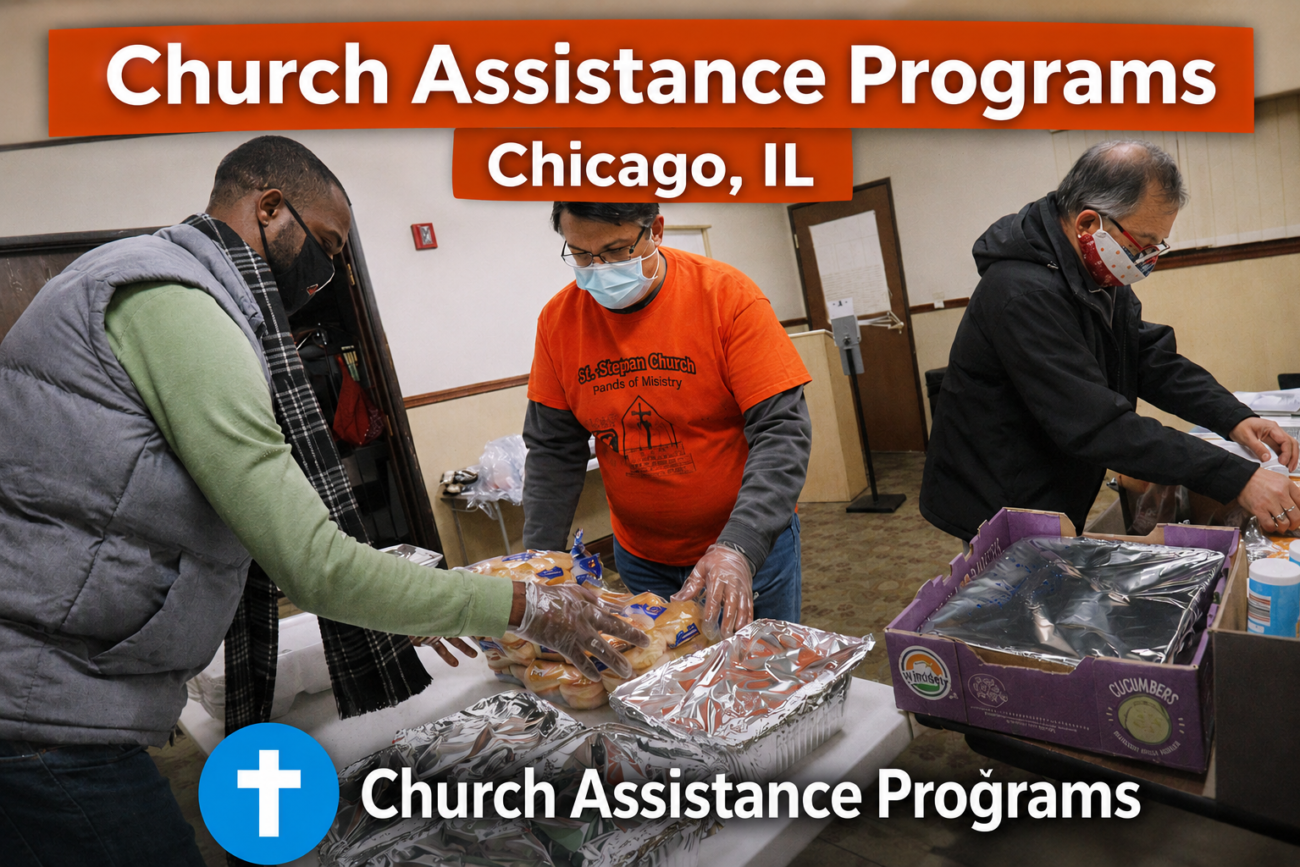
Churches and religious organizations across Chicago offer emergency financial assistance, housing, and food to residents facing economic crises. Depending on available funds and eligibility requirements, assistance may include help with rent, utilities, food, clothing, emergency shelter, case management, and other basic needs.
Major Church Assistance Programs in Chicago, IL
Catholic Charities of the Archdiocese of Chicago
Catholic Charities of the Archdiocese of Chicago operates an extensive network of essential support services, offering crisis stabilization, housing assistance, food security, and family counseling in Cook and Lake counties.
The primary access point for all programs is the Catholic Charities Help Line (312-655-7700), staffed Monday through Friday, 8:30 a.m. to 4:30 p.m.
How to Request Assistance and Document Checklist
Since financial assistance funds have monthly limits and are depleted quickly, applicants should prepare the following documents before calling the central intake line:
Proof of identity: Official photo ID of the primary applicant.
Proof of residence: Lease agreement, utility bill, or official correspondence verifying residency in Cook or Lake County.
Income verification: Recent pay stubs, benefit notification letters (SSI, SSDI, TANF), or bank statements.
Crisis notification: Physical five-day eviction notice, overdue utility bill, or utility disconnection notice.
The Salvation Army (Metropolitan Division)
The Salvation Army’s Northern and Central Illinois Division (historically known as the Metropolitan Division) coordinates emergency assistance, housing stabilization, and comprehensive case management in the Chicago metropolitan area.
Since financial assistance programs are administered locally, you must apply directly at the specific community center (Corps Community Center) assigned to your residential zip code. For inquiries regarding immediate assistance, you can contact the main office via The Salvation Army NCI Division website or by calling 773-725-1100.
Requirements for Financial Assistance Applications
When funds become available at local centers (Corps centers), you generally must present:
- A valid official photo ID and proof of your current Chicago address.
- Verification of total household income or proof of sudden financial hardship (such as medical bills or layoff notices).
- An official 5-day eviction notice signed by the landlord or a utility disconnection notice.
Society of St. Vincent de Paul Chicago
The Society of St. Vincent de Paul (SVdP) of Chicago operates as a highly localized charitable network rooted in neighborhoods. Unlike centralized social service agencies, its assistance is provided directly through volunteer groups known as “Conferences,” based at local Catholic parishes in Cook and Lake counties.
Instead of working from an office, SVdP volunteers (known as Vincentians) conduct home visits to meet with individuals, assess their needs in person, and deliver emergency aid directly. For general inquiries, you can contact the central council office via the Society of St. Vincent de Paul Chicago website or by calling 773-779-6700.
How the SVdP Assistance Process Works
Since assistance is managed entirely by neighborhood volunteers, the application process follows a unique model:
Locate your nearest parish conference: Call the central assistance line at 773-779-6700 or use their website to enter your address. You will be put in touch with the Society of St. Vincent de Paul (SVdP) volunteer group operating closest to your home.
Initial interview: A volunteer will review your application. If funds or resources are available in your neighborhood’s fund, they will schedule an appointment.
Home visit: Typically, two SVdP volunteers will visit your home. This visit is conducted without judgment and aims to understand your household’s full situation in order to maximize the financial, material, or emotional support offered.
Direct payment to providers: SVdP never hands cash directly to applicants. All approved financial assistance is paid directly via check to landlords, utility companies, pharmacies, or service providers.
Local church programs and day services
First United Methodist Church (The Chicago Temple)
First United Methodist Church, located in the “Chicago Temple” building, serves as an indispensable safety net in the city center, anchoring this skyscraper in the heart of the district known as “The Loop.”
Unlike neighborhood parishes that manage local funds for rent or utility payments, this historic church focuses its direct efforts on providing meals, clothing, legal counseling, and basic medical assistance to individuals experiencing homelessness or food insecurity.
How to access “Hope’s Table”
When: Services are offered every Saturday morning.
Who: Open to any individual or family facing financial hardship, food insecurity, or homelessness; no religious affiliation or documentation is required.
Fourth Presbyterian Church
Fourth Presbyterian Church provides vital community support along the “Magnificent Mile” through its dedicated Meals Ministry and its independent non-profit organization, the Chicago Lights Social Service Center.
Unlike agencies relying on centralized funding, this congregation dedicates its facilities to alleviating daily hunger, providing clothing, offering case management, and fostering youth development. Walk-in emergency assistance is available directly at the entrance located at 126 E. Chestnut Street.
How to access walk-in services
Registration for the Social Service Center and food pantry: Registration takes place strictly between 9:30 a.m. and 10:15 a.m., Tuesday through Friday. Enter through the glass doors at 126 E. Chestnut Street.
Food pantry appointments: While walk-ins are accepted during the intake process, scheduling an appointment by calling the center directly at 312-640-2571 is strongly recommended to avoid long wait times.
Pacific Garden Mission
Pacific Garden Mission is the oldest continuously operating social service mission in the United States; it offers immediate overnight emergency shelter, three hot meals a day, clothing, and long-term transformation programs for homeless individuals and families in Chicago.
Located just south of the Loop, the mission operates as an open-door safety net. Anyone seeking emergency shelter may arrive at any time of day or night. For immediate inquiries, you can contact the intake office via the official Pacific Garden Mission website or by calling 312-492-9410.
Rules for guests and what to expect
To ensure a safe environment for all families and individuals on the premises, the mission enforces clear rules:
Security screening: Everyone must pass through a standard security check and a metal detector upon entering the building.
Zero-tolerance policy: Alcohol, illegal substances, weapons, and aggressive behavior are strictly prohibited anywhere on the premises.
Daily check-in: Although the shelter remains open 24 hours a day for genuine emergencies, regular guests are encouraged to check in during the afternoon to secure their assigned bed and dinner.
How to access emergency help
Call 311: The City of Chicago uses the 311 system to route emergency requests—such as short-term financial aid, extreme weather shelters, and rental assistance programs—directly to participating faith-based organizations.
Contact local parishes directly: If you need help in your area, look for the church nearest your home and ask if they have a charity or diaconate fund to provide emergency support to neighbors.
