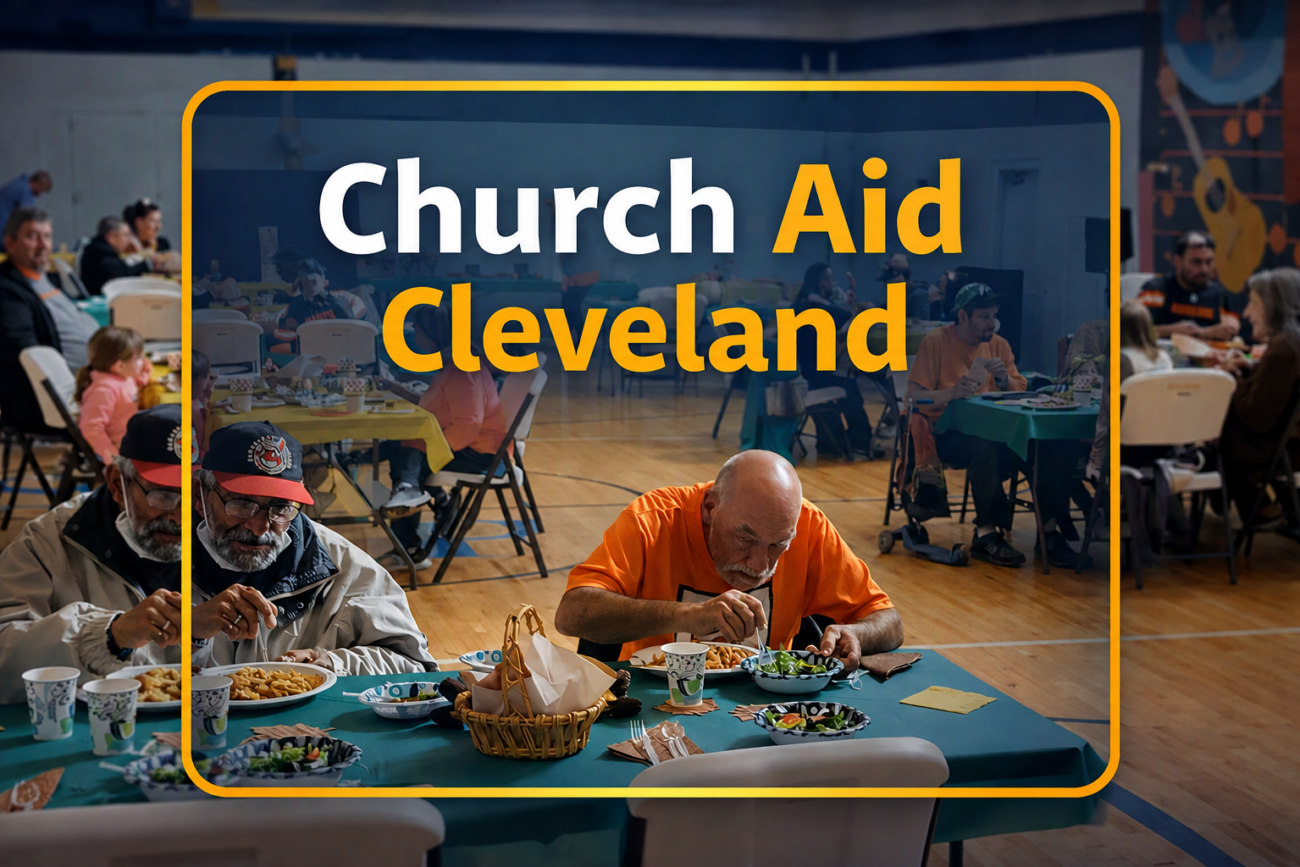
Several church-affiliated networks in Cleveland and Cuyahoga County offer emergency financial assistance for rent, utility bills, food, housing, and basic needs. Since these programs rely heavily on available funds and specific service areas (often defined by zip code), it is best to contact them directly or call United Way 2-1-1 Greater Cleveland for an initial assessment and immediate referral.
The following are the primary church-based assistance programs operating in the Cleveland area.
1. Society of St. Vincent de Paul (SVDP) of Cleveland
The Society of St. Vincent de Paul (SVDP) of Cleveland operates as a decentralized network of 63 parish-based groups (known as “Conferences”) and 7 centralized food assistance sites (“Hunger Centers”) across eight Northeast Ohio counties, with a primary focus on Cuyahoga County. Rather than offering long-term systemic aid, the SVDP specializes in immediate crisis intervention and personalized emergency assistance to prevent homelessness and hunger.
Emergency Financial Assistance (Parish Conferences)
Financial aid is managed entirely at the local level by volunteer groups operating within Catholic parishes.
Rent and Mortgage Assistance: Funds to prevent evictions or assist with security deposits.
Utility Shut-off Prevention: Emergency funds to maintain gas, water, and electric services.
Basic Needs and Vouchers: Vouchers for local thrift stores to obtain clothing, mattresses, blankets, and essential household furniture.
Home Visits: The SVDP employs a unique “home visit” model. When you request financial assistance, two volunteers (“Vincentians”) will arrange an in-person meeting at your home to discuss your situation, review your bills, and coordinate direct payments to landlords or utility companies.
How to Request Financial Assistance
Since assistance depends entirely on neighborhood boundaries, you must submit a request to the volunteer group assigned to your area.
Call the central hotline: Contact the SVDP Cleveland main line at 216-696-6525 or their specific helpline at 216-961-6036. Leave a detailed voicemail stating your name, phone number, address, and the specific bill you need help paying.
Referral to the parish: Central office staff will refer your message to the specific parish volunteers covering your area of residence. A local volunteer will call you back to schedule an initial assessment.
Document preparation: If a parish conference is actively funding requests, you will be asked to provide photo identification, Social Security cards for household members, proof of household income, and the physical eviction notice or overdue utility bill.
2. Catholic Charities, Diocese of Cleveland
Catholic Charities, Diocese of Cleveland, operates a comprehensive social services system throughout Northeast Ohio, specializing in small emergency financial grants, hunger relief, shelter, and basic needs verification. Aid is distributed based on county of residence and specific eligibility requirements.
Emergency financial assistance
Catholic Charities offers temporary financial crisis intervention to prevent displacement and the loss of essential household services.
Housing stability: Small crisis grants fund past-due rent, security deposits, or mortgage balances for individuals facing imminent eviction deadlines.
Utility assistance: Direct bill payments are designed to prevent the disconnection of gas, water, sewer, or electric services.
Basic survival needs: Program centers provide immediate aid items, such as RTA bus passes, clothing vouchers, and grocery store gift cards.
Steps to request financial assistance
Because funds are limited and subject to strict verification protocols, applicants must undergo a formal initial assessment process.
Contact the central intake office: Call the main line at 1-800-860-7373 (available Monday through Friday, 8:00 a.m. to 4:00 p.m.) to speak with an intake specialist who routes requests based on county.
Present household records: Be prepared to present government-issued photo IDs, Social Security cards for all residents, and official proof of household income (such as recent W-2 forms or benefit statements).
3. The Salvation Army of Greater Cleveland
The Salvation Army of Greater Cleveland operates as both a church and a social service network, distributing emergency aid throughout Cuyahoga County via local community centers (known as Community Corps Centers). Assistance is strictly limited by zip code, meaning you must apply at the specific center assigned to your neighborhood.
Emergency Financial Assistance
The Salvation Army provides crisis funding paid directly to landlords, property managers, or utility companies.
Rent and Mortgage Assistance: Emergency grants designed to halt ongoing eviction proceedings, cover past-due rent, or assist with security deposits to secure housing.
Utility Disconnection Prevention: Aid with overdue electricity, gas, water, and sewer bills. They often assist with applications for the HEAP (Home Energy Assistance Program) and re-enrollment in the PIPP (Percentage of Income Payment Plan).
Disaster Relief: Immediate financial, material, and emotional assistance for families displaced by house fires, floods, or localized natural disasters.
Food Security and Basic Needs
Choice-Based Food Pantries: Located at most community centers, these pantries offer a three-day emergency food supply (including fresh produce and meat when available) to families, once every 30 days.
Hot Meal Programs: Free community lunches and breakfasts served on specific days of the week at various neighborhood locations.
Mobile Feeding Unit (Mobile Canteen): A mobile unit that travels directly to high-need Cleveland neighborhoods to distribute hot meals and bottled water to individuals experiencing homelessness.
Housing, Shelter, and Specialized Care
Zelma George Family Emergency Shelter: A safe, temporary emergency shelter offering lodging, case management, and three daily meals to women and children experiencing homelessness. Harbor Light Complex (1710 Prospect Ave, Cleveland, OH 44115): A large multi-service facility offering specialized transitional housing, substance use disorder rehabilitation, and community reintegration programs. Location Directory (Where to go)
To receive emergency assistance with utilities, rent, or food pantry services, you must contact the center (Corps Center) assigned to your zip code:
Cleveland Temple Corps (17625 Grovewood Ave | 216-692-1388)
Zip codes covered: 44103, 44106, 44108, 44110, 44112, 44117, 44119, 44121, 44123, 44132, 44143.
Miles Park Corps (4129 E. 93rd St | 216-341-1690)
Zip codes covered: 44104, 44105, 44120, 44122, 44125, 44128, 44137, 44146.
Ohio City Corps (4415 Biddulph Ave | 216-631-1517)
Zip codes covered: 44102, 44109, 44111, 44113, 44114, 44115, 44135, 44144.
West Side Corps (4445 W. 35th St | 216-459-0028)
Zip codes covered: 44129, 44130, 44131, 44133, 44134, 44136, 44141, 44142, 44147, 44149.
Requirements for Intake
When you attend your scheduled intake appointment, you must bring physical copies of:
- Photo ID: For all adults in the household.
- Social Security cards: For all household members (including children).
- Proof of income: Recent pay stubs, SSI/SSDI benefit award letters, or Ohio Works First (OWF) documentation from the last 30 days.
- Proof of crisis situation: A recent utility bill showing a disconnection notice, or a court-ordered eviction or 3-day notice signed by the landlord.
4. Independent and interdenominational local church programs
Various community outreach programs run by independent, interdenominational, and non-profit local churches in Cleveland offer community-level emergency aid, operating outside of large denominational structures. These centers focus on basic survival services, housing placement, food security, and assistance with obtaining documentation.
Key independent and interdenominational church programs operating in Cleveland include:
West Side Catholic Center (WSCC)
Despite its name, the West Side Catholic Center operates as a comprehensive, independent, and interfaith resource center offering robust survival and housing programs.
Housing and shelter solutions: Manages Moriah House, an emergency residential shelter for homeless mothers and families. It also runs the Zacchaeus Housing Solutions program, which provides funding for rapid re-housing and case management services.
Drop-in day services: Offers visitors access to hot meals, showers, use of a public phone, personal mailboxes, and professional barber services.
Documentation assistance: Provides specialized vouchers to cover the state fees required to obtain official birth certificates and government-issued photo IDs.
St. Paul’s Community Church (UCC) Community Outreach Center
Located in Ohio City, St. Paul’s community outreach program offers a centralized neighborhood service hub.
Hours of operation: Open Tuesdays, Wednesdays, and Thursdays from 9:00 a.m. to 2:00 p.m.
Services offered: Coordinates an on-site food pantry, charging stations, public restrooms, and a walk-in clothing distribution program (operating on the second and fourth Wednesday of each month).
Specialized assistance: Organizes dedicated housing assistance sessions on Thursdays and offers an ID voucher program from Tuesday through Thursday to help neighbors pay for official state identification.
Mega Church Resource Center
Located in the southern area near the city center, the Mega Resource Center offers services to support neighborhood stability on a walk-in basis.
Service hours: Open for walk-ins on Mondays and Fridays from 11:00 a.m. to 2:00 p.m.
Emergency distribution: Provides emergency food and clothing to Cuyahoga County residents.
Service guidance: Volunteers assist individuals personally with enrollment in government assistance programs (such as SNAP or HEAP) and provide direct referrals to regional housing agencies.
How to access independent programs
Because independent, church-run centers operate under flexible, community-oriented guidelines—rather than strict geographic restrictions based on zip codes—the requirements for receiving help are simple:
Walk-ins for immediate basic needs: Services such as hot meals, clothing closets, showers, and emergency food pantries typically serve individuals on a walk-in basis during morning or midday hours.
Call ahead for housing and vouchers: Specialized funding programs—such as vouchers for identification documents or rapid re-housing case management—often require an appointment or have strict daily limits on the number of available vouchers.
Required documentation: Always bring a photo ID and a recent utility bill or lease agreement to prove residency in Cuyahoga County when requesting food aid or assistance with documentation.
