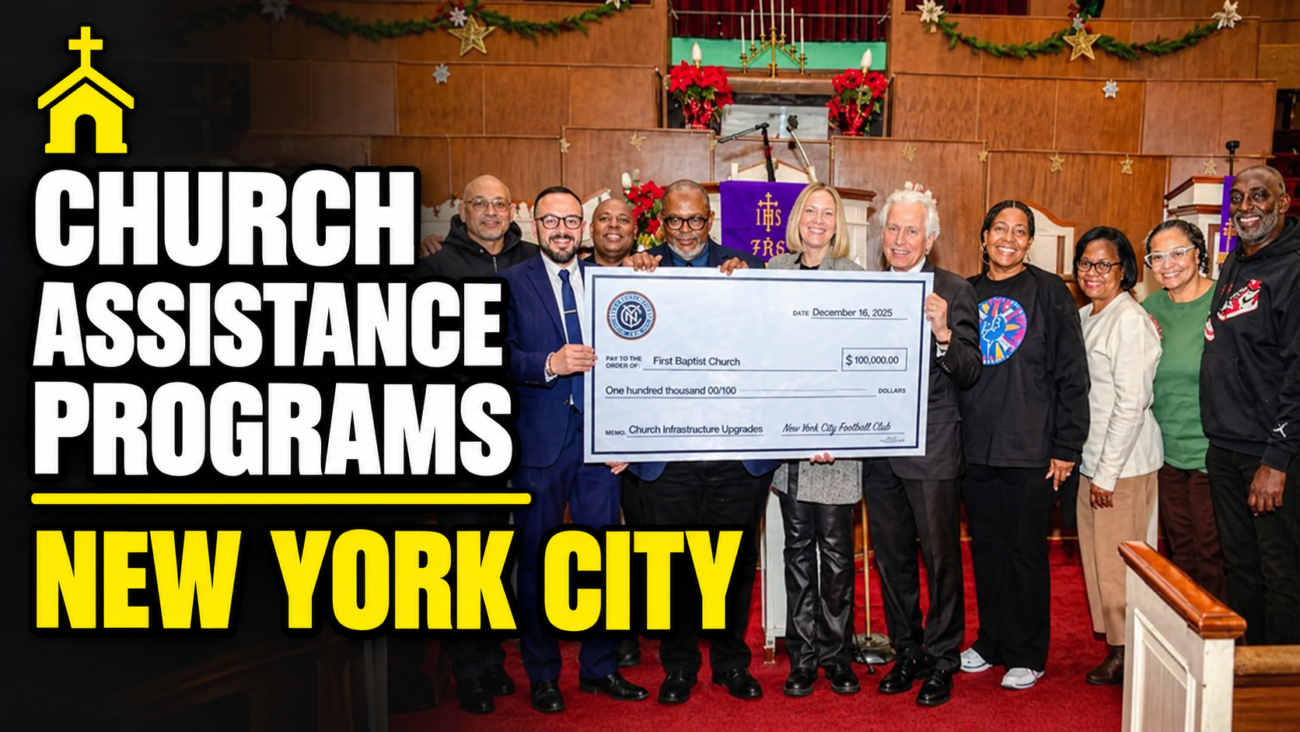
Church-based assistance programs in New York City provide a vital safety net for residents facing financial crises, housing instability, or food insecurity. Generally, these services are open to all New Yorkers, regardless of religious affiliation.
Since many of these initiatives operate at the local level, a geographic perspective can help you identify the support resources closest to you.
Emergency Financial Assistance and Eviction Prevention
Several major church-affiliated networks provide emergency financial assistance to help individuals catch up on rent, avoid utility shut-offs, and secure emergency housing.
Catholic Charities Community Services
Catholic Charities Community Services (CCCS) offers targeted eviction prevention services and emergency crisis assistance to help vulnerable New Yorkers maintain stable housing and overcome financial hardships. These programs combine strategic advocacy, legal guidance, and temporary financial assistance.
Housing and Eviction Prevention Framework
CCCS deploys comprehensive social workers to help clients address immediate threats from landlords or housing court through several specialized avenues:
Eviction Prevention Grant Program (EPGP): Designed specifically for individuals or families facing active housing-related legal proceedings. Case managers assess the tenant’s legal situation, provide limited direct legal representation, communicate with landlords, and help secure financial resources to settle accumulated arrears.
Housing Subsidy Guidance: Staff in Manhattan and the Bronx guide eligible tenants through the complex application processes for local public funding. This includes securing the New York City Family Homelessness & Eviction Prevention Supplement (FHEPS) and Emergency Assistance to Families and Children (EAF) to cover a portion of monthly rent obligations.
Tenant education and mediation: Staff provide active mediation services between tenants and landlords to resolve disputes before they escalate to formal eviction proceedings, while also offering education on budget management to ensure continued rent payments in the future.
Emergency financial assistance and basic needs
When an immediate financial crisis threatens a household’s safety or access to utilities, CCCS case managers can intervene with emergency measures:
Utility shut-off prevention: Limited financial assistance is available to settle outstanding electricity or gas debts and prevent service interruption.
Emergency stabilization grants: Limited, one-time funds may be allocated on a case-by-case basis to cover critical basic needs, such as paying rent arrears or purchasing food urgently.
Intake and Eligibility Process
Assistance is allocated based on eligibility assessments, the severity of the legal situation, and the availability of funds. Services are non-religious in nature and open to all New York City residents, regardless of religion.
Main Helpline: Call the Catholic Charities helpline at 888-744-7900, Monday through Friday, between 8:00 a.m. and 5:30 p.m. Trained specialists will assess your current situation and refer your case to the appropriate regional program or EPGP specialist.
Main Administrative Office: 80 Maiden Lane, 23rd Floor, New York, NY 10038.
Catholic Charities Homebase Programs
Catholic Charities Homebase programs operate as a specialized homelessness prevention network funded by the New York City Department of Social Services. Unlike general outreach crisis centers, Homebase centers serve specific neighborhood zip codes. Their goal is to assist families and individuals at imminent risk of entering the New York City shelter system due to rent arrears, extreme overcrowding, or hazardous living conditions.
If you are facing housing instability in Brooklyn, Queens, or the Bronx, Catholic Charities has several physical Homebase locations to coordinate your care.
Catholic Charities Homebase Offices by Borough
Since eligibility for the New York City Homebase program depends strictly on your current residential zip code, you must contact or visit the office serving your area.
Queens Centers
The Catholic Charities Homebase network for Brooklyn and Queens covers all zip codes in the Queens region.
Jamaica Center: 161-10 Jamaica Ave, Jamaica, NY 11432 | Phone: 718-674-1000 | Email: Intake@ccbq.org
Far Rockaway Center: 18-47 Mott Ave, Far Rockaway, NY 11691 (Note: The physical location may be undergoing renovations; please call before visiting) | Phone: 718-647-1015 | Email: Intake@ccbq.org
Brooklyn Centers
Specific Brooklyn zip codes are served by specialized family support centers and community centers.
East Flatbush / Canarsie Center: 1900A Ralph Ave, Brooklyn, NY 11234 (Serves zip codes 11203, 11234, and 11236) | Phone: 718-514-8034 | Email: IntakeBK4@ccbq.org
East New York / Brownsville Centers: 560 Livonia Ave, Brooklyn, NY 11207 or the Dr. Lutas Family Support Center at 3060 Fulton St, Brooklyn, NY 11208 (Serves zip codes 11207, 11208, and 11239) | Phone: 718-408-7181 or 929-234-3036 | Email: IntakeBK5@ccbq.org
Bronx Locations
Catholic Charities Community Services operates several Homebase divisions throughout the Bronx.
East Bronx / Parkchester Office: 4377 Bronx Blvd, Suite 303, Bronx, NY 10466 (Serves zip codes 11461, 10464, 10465, 10466, 10469, 10475) | Phone: 347-947-3920
Soundview / Hunts Point Offices: The Blackrock Ave (Phone: 718-414-1050) or Garrison Ave (Phone: 929-259-9430) locations handle intake for local families (Serving zip codes 10462, 10472, 10473, 10474).
Food Security and Community Meals
If you are seeking immediate food assistance, daily pantry services and community dinners are available throughout the city.
The Urban Outreach Center of NYC
The Urban Outreach Center of NYC (UOCNYC) helps fight hunger in East Harlem and the Upper East Side by providing restaurant-quality food, essential items, and comprehensive social services—all with dignity and hospitality. Reaching over 65,000 New Yorkers annually across the five boroughs, their operations focus on community health, low-barrier access, and addressing the root causes of poverty.
1. Farmers’ Market-Style Food Pantry
The UOC food pantry is designed to offer a grocery store-like experience, where individuals can choose their own fresh produce and healthy staples rather than receiving pre-packed boxes. Schedule: Every Wednesday and Friday, from 9:00 a.m. to 1:00 p.m.
Items provided: In addition to fresh, seasonal fruits and vegetables, individuals experiencing homelessness can also request essential supplies such as new socks and underwear, hygiene kits, and sleeping bags.
2. Tuesday Night Community Dinner
Each week, the center provides a hot, nutritious meal—restaurant-quality and ready-to-go—to hundreds of community members facing food insecurity. Past meals have included balanced menus such as meatloaf with mashed potatoes and fresh green beans, accompanied by salad and fresh fruit.
Schedule: Every Tuesday, from 5:30 p.m. to 6:30 p.m.
3. Beyond Food: Comprehensive Social Services
Recognizing that food insecurity is often linked to housing instability, the center incorporates complementary essential support services directly into its food pantry’s operating hours:
Temporary mailing address: Homeless individuals can use the center’s official address to receive mail securely; this enables them to obtain valid state identification, apply for public benefits, and seek employment. Mail distribution takes place on Wednesdays and Fridays from 9:00 a.m. to 1:00 p.m.
Hygiene and showers: The center offers a free clothing closet and professional shower facilities—stocked with clean towels and toiletries—to support the health and job readiness of those they serve.
Crossroads Community Services
Crossroads Community Services provides vital food security assistance and emergency meals to homeless and low-income New Yorkers from its headquarters in Midtown Manhattan. In partnership with St. Bartholomew’s Church, the organization serves over 300,000 meals annually through a combination of daily grab-and-go meal programs and a client-choice food pantry.
1. Daily grab-and-go meal schedule
Meals are open to the general public at no cost; no documentation or referral is required to receive a hot meal or a grab-and-go food package:
Grab-and-go breakfast: Available Sundays, Mondays, and Wednesdays from 7:45 a.m. to 8:45 a.m. Volunteers prepare fresh, hot food and offer cereal, milk, coffee, fresh fruit, and sandwiches.
Grab-and-go brunch: Available Saturdays from 10:00 a.m. to 11:00 a.m. This distribution, known as the “Saturday Café,” offers hot entrées, complimentary pastries, fruit, and coffee.
Grab-and-go dinner: Available daily (Monday through Sunday) from 5:30 p.m. to 6:30 p.m. These dinners, organized in partnership with the Coalition for the Homeless, are prepared using fresh food recovered and donated by local hotels and restaurants.
2. Client-choice food pantry
The pantry distributes bags of healthy food, including high-quality proteins, whole grains, dry goods, and fresh seasonal fruits and vegetables. Food quantities are adjusted based on family size.
Pantry hours: Thursdays from 9:30 a.m. to 12:45 p.m.
Appointment requirement: You must schedule a slot in advance. You can register via the Plentiful app, by emailing pantry@crossroadsnyc.org, or by calling 212-378-0234 (ext. 3).
Initial registration: On your first visit, please present valid identification and recent proof of New York City residency for all household members. Households may use the pantry once a month.
Family support and job readiness services
Long-term stability programs focus on childcare, mental health resources, and job readiness training.
Episcopal Social Services of NY (ESS)
Episcopal Social Services of NY (ESS) is no longer in operation. In 2015, this organization—with a 180-year history—officially changed its name to Sheltering Arms Children and Family Services. Due to severe revenue shortfalls caused by the pandemic and prolonged delays in municipal contract reimbursements, Sheltering Arms ceased all operations and closed its doors.
If you need immediate assistance with family resources or job training, we recommend contacting the following citywide networks:
Rising Ground Administrative Offices: Contact them directly to inquire about active youth employment programs or behavioral health clinics that became part of Rising Ground following the closure of Sheltering Arms.
Phone: 914-375-8700
NYC 311 Social Services Directory: You can call 311 or use the online portal to find active local programs—currently funded by the city—focused on family stabilization, after-school care, or job placement.
