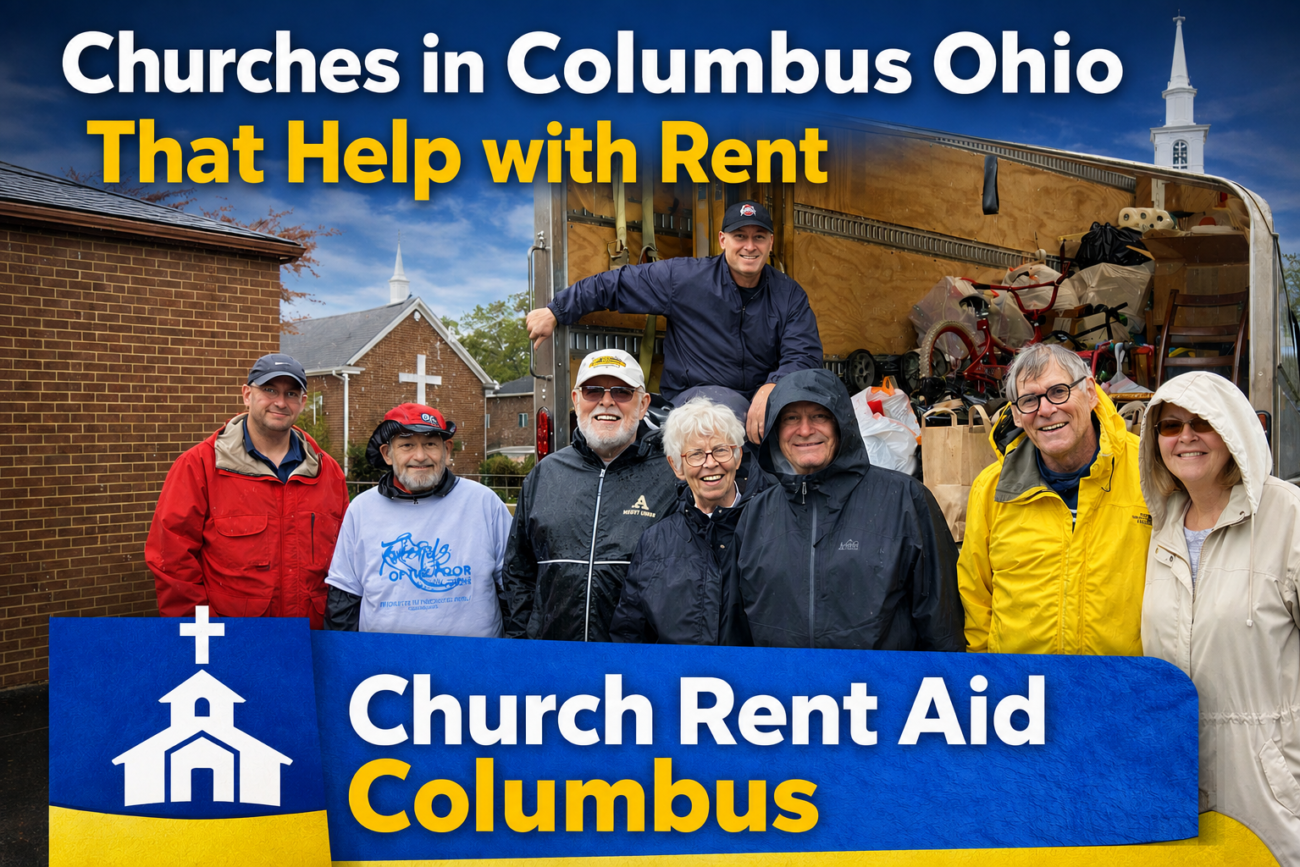
Several churches and religious ministries in Columbus, Ohio, offer direct rental assistance or emergency stabilization programs to help residents avoid eviction. Since funds are often limited and depend on the time of the month or available grants, most of these churches operate based on strict zip code restrictions or through coordinated telephone lines.
Top Churches in Columbus Ohio That Help with Rent
Broad Street Presbyterian Church (COMPASS Program)
Broad Street Presbyterian Church’s COMPASS rent and utility assistance program is an emergency financial aid ministry designed to prevent homelessness and halt evictions for low-income residents in Franklin County and Columbus, Ohio.
Application and Eligibility Requirements
The program follows specific, strict guidelines for evaluating applications for emergency rent funds:
Source of income: You must have an active source of income (employment, SSI/SSDI, or public benefits).
Proof of financial hardship: You must provide a notice of late rent payment along with verifiable, documented proof of a sudden financial emergency or hardship situation (e.g., a medical emergency or temporary job loss).
Frequency: This program offers one-time assistance. You are ineligible if you have received financial support from COMPASS within the last 12 months (some funding allocations strictly limit this to a once-in-a-lifetime benefit).
No guarantees: Submitting an inquiry or application does not guarantee approval or the receipt of funds. Applications are only thoroughly reviewed once all required documentation has been submitted.
No walk-ins
The church does not accept walk-ins or in-person document drop-offs for financial assistance requests. You must apply remotely to begin the intake process.
How to Apply for Assistance
To request an application for rent assistance, you must contact the dedicated COMPASS intake lines directly:
By phone: Leave a clear voicemail detailing your request on the intake line: (614) 429-5979.
By email: Send a formal inquiry to compass@bspc.org.
Note: For general inquiries about the church, the main building is located at 760 E Broad St, Columbus, OH 43205; however, staff will redirect all calls regarding financial assistance to the specific COMPASS lines listed above.
Society of St. Vincent de Paul (Catholic Diocese of Columbus)
The Columbus Diocesan Council of the Society of St. Vincent de Paul (SVdP) provides financial and emergency rental assistance to families facing eviction throughout Central Ohio.
The Columbus Diocesan Council of the Society of St. Vincent de Paul (SVdP) provides financial and emergency rental assistance to families facing eviction throughout Central Ohio.
Location and contact options
To request emergency assistance for rent, utilities, or material needs, you must direct your request based on your neighborhood or parish boundaries.
Central Helpline Contact: You may call the dedicated St. Vincent de Paul request line at (614) 302-2517 or the Diocesan Office general helpline at (614) 376-3604 (available Mondays, Tuesdays, and Thursdays). Operators will ask for your zip code and connect you with the active conference serving your neighborhood.
Parish hotlines: Many Columbus neighborhoods manage their own independent phone lines to receive requests. Examples include:
Near East Side / Victorian Village (St. Francis of Assisi Conference): Call their dedicated line directly at (614) 388-8279.
North Columbus / Linden Area (St. Augustine and St. Gabriel Conference): Call their specific helpline at (614) 636-0880.
Physical administrative office: 5969 E Main St, Columbus, OH 43213 (Note: This location handles administrative and systemic change programs; direct same-day cash payments or requests are processed remotely or via home visits).
The application process and the “home visit”
SVdP operates differently from traditional government rental assistance programs. Its process prioritizes direct relationships:
Receiving requests by phone: You leave a detailed message on the appropriate helpline with your name, phone number, address, zip code, and a description of your financial crisis.
The home visit: If the local conference has funds available, a pair of trained volunteers (called Vincentians) will call you back to schedule a mandatory “home visit.” They will meet with you at your home to hear your story, verify your situation, and pray with you if you feel comfortable doing so.
Direct payment to the landlord: If the request is approved, SVdP pays the landlord directly via a corporate check. They do not give money or cash directly to the applicant.
Eligibility rules and requirements
Focus on crisis situations: Funds are intended for emergency eviction prevention. They serve as temporary, one-time support following a sudden loss of income, rather than a long-term subsidy.
Strict boundaries: A parish conference can only assist you if you live within the specific geographic boundaries assigned to that parish. If your neighborhood conference exhausts its funds for the month, it cannot request assistance from a neighboring church.
Landlord cooperation: The landlord must agree to collaborate with SVdP, complete an IRS Form W-9, and halt the eviction process once payment is approved.
The Salvation Army of Central Ohio
The Salvation Army of Central Ohio offers emergency assistance programs for rent and utilities, designed to help families retain their homes and prevent homelessness in Franklin, Delaware, and Union counties. Since funding relies heavily on seasonal grant allocations and local church budgets, the program operates under strict poverty-level criteria and utilizes locally assigned social workers.
Eligibility and requirements
To qualify for emergency rental assistance through The Salvation Army, applicants must meet the following basic conditions:
Income limits: Generally, your household income must be at or below 125% of the federal poverty thresholds.
Crisis situation: You must demonstrate a verifiable financial crisis (e.g., job loss, medical emergency, or an active eviction notice).
Required documentation: You will need to provide proof of income for all household members, a copy of your current lease agreement, and a statement from the landlord or an account record detailing the exact amount owed.
How to Apply
The application process can be started online or by phone.
Online Portal: The fastest way to request assistance and find an available caseworker is through the SAHelp.org registration system. By entering your zip code, the portal determines if funds are available for your neighborhood and sends your information directly to a local intake worker.
By Phone: You can call the main assistance line directly at (614) 253-6811 or contact regional community centers to check on funding status.
Program Coordination Tip
If local Salvation Army funds for rent payments have temporarily run out for the month, ask your assigned caseworker about active programs for utilities (electric, gas, water). They often administer AEP Ohio’s “Neighbor to Neighbor” program and Columbia Gas’s “HeatShare” grant. Offsetting a high utility bill with these grants can help free up your own money to pay your landlord directly.
United Methodist Church for All People
The United Methodist Church for All People, operating alongside its nonprofit organization Community Development for All People (CD4AP), takes a unique approach to rental assistance.
Unlike ministries that issue emergency checks to immediately cover overdue rent, this church focuses on long-term housing stabilization, affordable housing creation, and systemic support for residents of Columbus’s South Side.
Structural Housing and Stabilization Programs
Affordable Housing Construction: CD4AP actively builds, rehabilitates, and manages high-quality, affordable rental units directly in the South Side area to prevent resident displacement.
“ID for All People” Program: Landlords and housing authorities require official documentation before approving a lease agreement. This program helps Columbus residents navigate the complex legal process of recovering lost birth certificates and obtaining state ID cards by covering the application fees in full.
Eviction Assistance: While they rarely offer direct cash grants for rent, their housing team helps low-income tenants handle eviction notices, access legal resources, and transition to safer, more stable living situations.
Location and Contact Information
Physical Address: 946 Parsons Ave, Columbus, OH 43206
Main Phone: (614) 445-7342
ID Recovery Line: Call (614) 445-7342, extension 129, to schedule an appointment for assistance in obtaining an ID or birth certificate.
Additional Crisis Resources
If you are struggling to pay rent, you can turn to the church’s free programs to meet basic needs and ease the burden of household bills, thereby freeing up funds to pay your landlord:
The Free Store: Offers gently used clothing and essential household items to families in need at no cost.
All People’s Fresh Market: Offers high-quality fresh produce and healthy food for free. It is located directly across the street at 945 Parsons Ave, Columbus, OH 43206.
Essential City-Wide Intake Systems
Many churches in Columbus now pool their resources into centralized community action centers rather than handling requests directly at their own facilities. If church budgets have been exhausted, the following are the best immediate points of contact:
LSS 211 Central Ohio: Managed by Lutheran Social Services; dialing 2-1-1 or calling (614) 221-6766 connects you to a unified database of all active utility and rent assistance grants in Franklin County. They can instantly tell you which local churches currently have funds available for your zip code.
Rentful 614: An official Franklin County eviction prevention resource portal that coordinates municipal funds and connects residents with local guidance centers, such as Gladden Community House and IMPACT Community Action.
Tips for requesting rent assistance from churches
When requesting rent assistance from a church, you are dealing with small committees of volunteers or pastors who manage limited funds derived from donations. To get your request approved, you must demonstrate two things: that the emergency was beyond your control and that a one-time payment will fully resolve the issue.
Following a structured communication strategy will help you stand out and secure funding.
The initial call: What to say
Churches receive a large volume of generic voicemails. Stand out by being incredibly specific, brief, and organized.
Use this exact script for your initial voicemail or email:
“My name is [Name], my phone number is [Phone number], and I live in zip code [Zip code]. I am facing an urgent eviction notice for a total of $[Total amount owed]. I have $[Amount you have] ready to pay, and I am calling to see if your church can offer a partial payment pledge of $[Specific amount needed] to cover the difference. I have a copy of my lease, payment records, and proof of financial hardship ready to send immediately.”
The 3 Rules of Church Financial Commitments
The “stacking” method: Most churches cannot afford to pay a $1,200 rent bill on their own. They prefer to offer pledges of between $200 and $400. You need to call several churches and “stack” their pledges of assistance until the total balance is covered.
Demonstrate that you can pay the rest: A church is unlikely to approve a $300 pledge if you have no way to cover the remaining $900. They do not want their donation to go to waste if you end up being evicted anyway. Always accurately disclose who else is helping you cover the difference.
No direct cash handouts: Churches will never hand cash or a check directly to you. They require your landlord’s legal business name and tax information (W-9 form), as they mail the check directly to the property management office.
List of Required Documents
Before a church volunteer reviews your situation, you must have digital photos or PDF copies of these four documents ready to send via text or email:
Lease agreement: Must show your name, address, monthly rent amount, and signatures.
Landlord account record: A formal statement from your landlord showing a detailed (line-by-line) breakdown of exactly which months and late fees you owe. (Text messages from the landlord are not accepted).
Proof of financial hardship: A document explaining why you fell behind on payments. This includes medical bills, car repair receipts, a layoff notice, or a temporary worker compensation letter.
Proof of future income: Pay stubs or a benefits letter demonstrating that, once the church helps you this month, you will have sufficient income to pay your rent next month.
